In 2012, as Britain reeled from yet another bout of devastating flooding, I wrote a blog post for ESI and External Works: ‘Floods crisis; Government indecision and delay must stop now.
Three years on, has policy and practice on surface water management achieved the progress we were so longing for? The winter of 2015 could be a severe one for the UK, according to some meteorologists, so will we be any better prepared for surface water flooding if the worst happens?
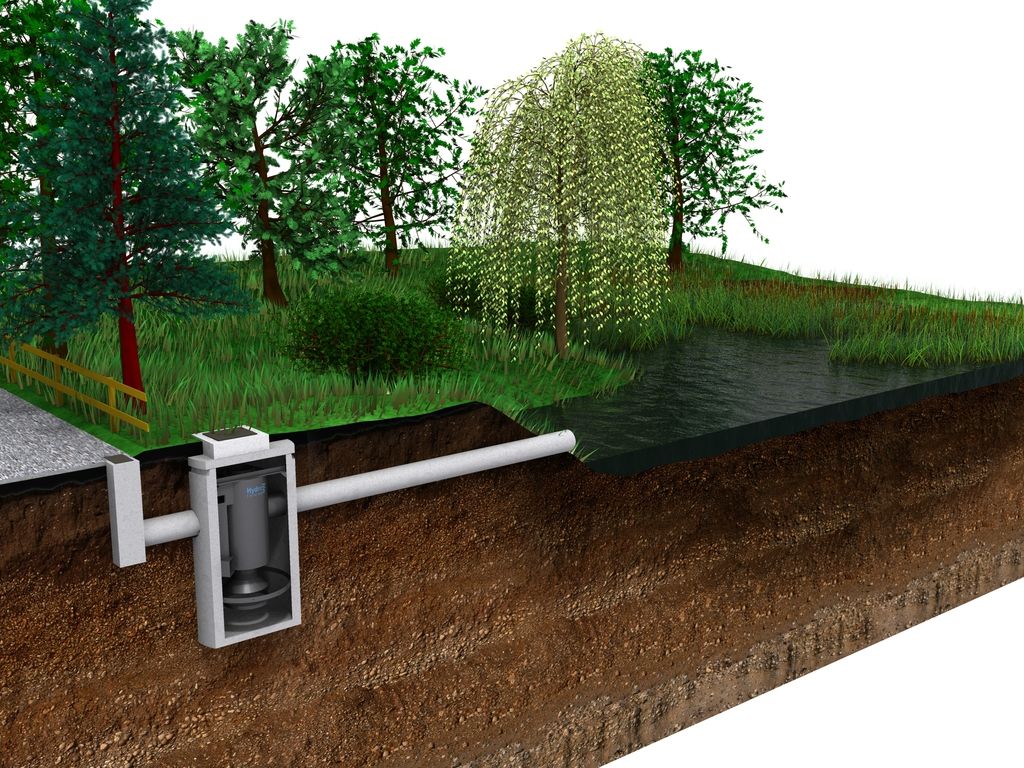
Precision-engineered devices such as the Hydro Downstream Defender enable multi-functional SuDS
Watered down regulations
After all that Government indecision, it was still something of a shock to the industry when the proposed Flood and Water Management Act (FMWA) measures I outlined in my 2012 blog were scrapped. More than 10 years of wrangling over legislation to make Sustainable Drainage Systems (SuDS) compulsory came to an end. But significantly watered-down regulations have now been introduced in England that intend to deliver Sustainable Drainage Systems via local authority planning. The requirements for SuDS only on major development (10 or more properties or equivalent commercial schemes) are covered by just two pages of technical guidance, a mere shadow of what many had hoped for.
While there is an expectation for SuDS to be built, the regulations fall short of being compulsory and the automatic right of developers to connect to the public sewer remains. So, the regulations leave the door ajar for developers to avoid using SuDS if they are considered unviable and for planning authorities to judge the requirement for SuDS to be trumped by other material planning considerations. Only time will tell how the guidelines will be interpreted as part of the planning balance.
Adoption and maintenance - problems and solutions
Under the original proposals, local authorities were to be responsible for adopting and maintaining all SUDS in new developments. Under the new regime, the Government made it clear that planning authorities are expected to grant developers permission only if they specify how the drainage will be maintained through the lifetime of the development. Without one single adopting body to become expert in the performance and maintenance of surface water drainage systems, a situation remains where disputes over ownership and maintenance can arise.
The problem is that ‘natural’ above-ground SuDS components such as ponds, swales or basins may be seen as the ‘ideal’, but they do not always lend themselves to the predictable, repeatable maintenance schedules that make it straightforward for a non-specialist land management company, local authority or water company to take them on. Residents themselves may be reluctant to pay for maintenance of SuDS components as part of their management fee.
Nevertheless, solutions are possible, if there is a practical, can-do attitude to change. All drainage systems, whatever components are used in their design, are precision-engineered systems. To build a management train, designers have to consider parameters such as rate of infiltration, discharge into a watercourse, the volume of flood storage, the pollutants to be removed and so on.
Any precision engineered system needs to be regularly monitored. To ensure it continues to work as designed, it has to be maintained appropriately in a way the designer specifies.
So how can the developer make sure that the design or maintenance of a sustainable drainage scheme doesn’t become a sticking point that could block, or delay, a planning submission? Proprietary devices provide the scientific evidence of surface water control and / or pollutant removal that can satisfy the authorities, with clear schedules outlined by the manufacturer.
A combined approach?
Using a combined approach, which engineers a sustainable solution using both natural and manufactured approaches together, could be the answer to achieving biodiversity and amenity, while still providing measurable operation and clear servicing schedules.
Another key barrier to progress is also solved by using precision-engineered solutions with a mix of natural and manufactured components. With the help of manufacturers’ specialist design advice, land-take and construction cost limitations can be avoided by engineering space-saving solutions that still work to sustainable objectives.
Regulations in Scotland and Wales
Different regulations apply for SuDS in Scotland, and in Wales it looks likely that the Assembly will stick much more closely to the Flood and Water Management Act model. All in all, the amount of SuDS you see in your local area may depend your local authority’s level of enthusiasm for it, and the other pressures for local housing and town planning.
However, the principle of sound, precision-engineered solution still stands. It can be the pragmatic answer that creates clarity where the regulations may lack it. At Hydro we will continue to champion this point of view.
For more information and advice on the use of proprietary Sustainable Drainage Systems you can visit Hydro International’s SuDS knowledge website www.engineeringnaturesway.co.uk.