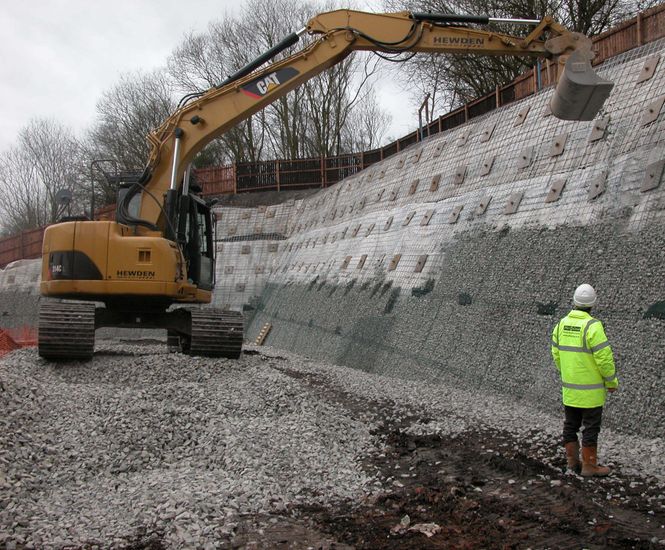


Keller offers a complete design and construct service using rotary and rotary percussive drilling methods to install both hollow and solid bar soil nails. We maintain a variety of plant so that they can deal with the challenges of site conditions and productivity targets. With available development land becoming ever more costly, gaining usable space on steeply sloping sites is paramount.
Benefits of soil nailing
- Soil nailing techniques are often an ideal solution, combined with the group's range of facing products, yielding maximum space gains whilst working safely with significant height temporary earthworks profiles.
- Expensive temporary works are avoided by using top down construction methods, with each subsequent row of nails providing both temporary and long term support.
- Elimination of the need for expensive stone backfill imported to site.
- Existing structures and embankments can be stabilised without rebuilding, saving costs and maintaining serviceability, for example, existing railway embankments.
- Trees, vegetation or architectural features can often remain unaffected by soil nails, as the nails can be sited to pass around or between obstacles.
Typical applications
- Stabilising steep cuttings to maximise development space.
- Stabilising existing over-steep embankments.
- Soil nailing through existing concrete or masonry structures such as failing retaining walls and bridge abutments to provide long term stability without demolition and rebuild costs.
- Temporary support can be provided to excavations without the need for bulky and intrusive scaffold type temporary works solutions.
Facing solutions
- Soil Panel vegetated slope
- Soil Panel with stone infill
- Permacrib