

- Sector
- Leisure and hospitality
- Year completed
- 2013
- Client
- Rosewood Hotels and Resorts, L.L.C.
- Products used
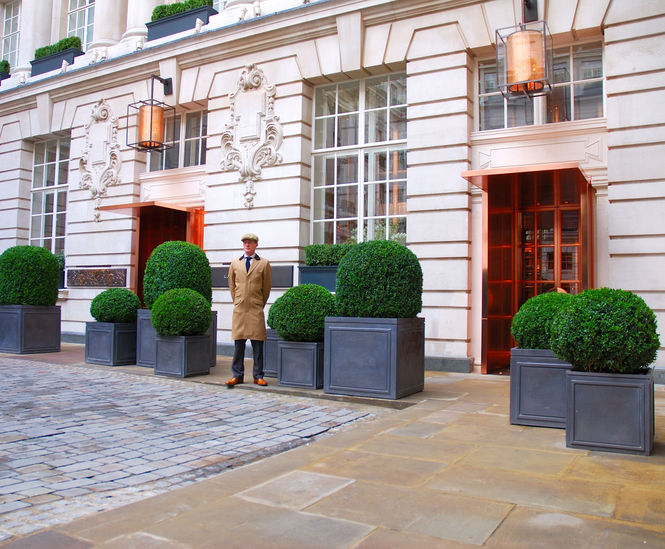
- Bespoke lead clad steel planters
Challenge
Lead-clad steel planters were commissioned for the newly-opened Rosewood London hotel, following an £85m refurbishment of the landmark Pearl Assurance headquarters on High Holborn.
The original design intent was for the planters to be manufactured in solid lead, but this created two key problems:
- 4 nr. imposing conical planters [W 1190 x H 1196mm] were too large to be made in solid lead, as the planters would collapse under their own weight.
- 10 nr. large trough planters were too heavy in solid lead to be safely installed on top of a wall surrounding an outdoor seating area.
Given the status of Rosewood London as one of the city’s foremost luxury hotels, the solution had to meet the highest standards of aesthetic finish, durability and longevity.
Solution
The solution was to design and manufacture stainless steel planter liners, which were then clad in 3mm thick lead sheeting. The resulting composite planters deliver the aesthetic of lead desired by the architect, whilst relying on the superior strength and strength-to-weight ratio of steel for the planters’ technical performance.
The 1196mm tall conical planters created a particular challenge, and were fabricated in two sections to realise the complex lip detail. The steel planters also had to accept the significant loadings of the lead cladding, and the conical planters were stiffened internally with a series of circular bands welded horizontally.
Given the use of dissimilar metals for this solution, a galvanic corrosion resistant coating was laid as a barrier between the outer lead cladding and steel liner.
Outcome
Using the above innovative techniques, robust steel planter liners can be clad not only with lead, but also with other soft metals – such as brass and copper. The resulting composite planters are typically stronger and lighter, and can be made larger, than would be the case using the soft metals alone; and this extends the use of the soft metals into environments and applications which were previously not possible.
IOTA can also combine steel planter structures with other non-metallic materials, such as timber, stone or ceramic; and planters can also be made utilising high tech composite panels, such as Aluminium Plastic Composite.