

- Sector
- Transport infrastructure
- Project type
- New build
- Services provided
- Planning advice
- Design
- Installation
- Year completed
- 2012
- Project location
- London
- Client
- Transport for London
Challenge
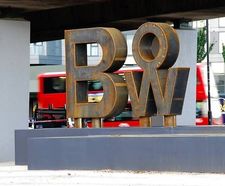
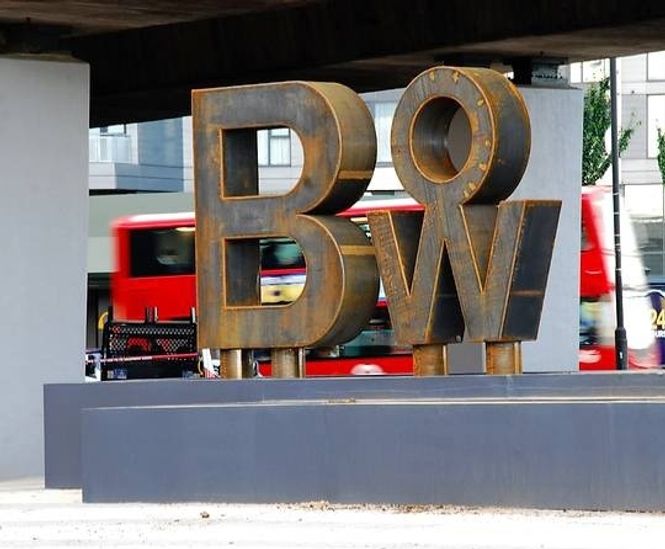
Transport for London had commissioned a pair of massive corten sculptures for installation on both sides of the roundabout by the Bow flyover. The development was part of the wider regeneration of the surroundings to the Olympic Park.
Spelling out “Bow” in a large, striking arrangement of letters, the sculptures would help to celebrate the locality. At the same time, they would be set alongside colourful floral displays, introducing natural elements into the busy, built-up area.
Both the sculptures and the floral displays were to be set in a continuous run of co-ordinating, purpose-made trough-shaped boxes. While all of these raised beds would have to look the same, those in which the sculptures were installed would need an entirely different specification to those designed for the plantings.
Solution
Livingreen worked with the contractors, Jacobs and Eurovia, to engineer special boxes to contain the sculpture bases while integrating with matching 13m-long raised planter beds.
Making full use of its in-house design capability and the expertise of its own product designers, Livingreen took the original concept and produced construction drawings for the scheme. The company then designed and manufactured the bespoke trough-shaped planting boxes.
The end-section boxes that would conceal the sculpture bases also had to accommodate tonnes of concrete foundation, which needed to be poured in to secure the artworks. Livingreen made them using a different strength of glass fibre and included an additional “wine-rack” format metal support structure. At the same time, they were produced with the same attractive finish as the other sections, which only had to accommodate plantings, soil and compost.
Livingreen’s experienced laminators fitted the sectional planters together and joined them on site, applying the finishing coats only when the structure was complete.
Elsewhere in Olympic Village, Livingreen designed and manufactured interior planters for hospitality areas as well as products for the “kiss and cry” areas in sports venues.
Outcome
The sculptures and the planters attracted positive comments from local people and from visitors, and greatly improved the local landscape.
Even more notably, Livingreen ensured that the design, manufacture and installation process fitted in an especially tight schedule.
The lead-time between the project being agreed and the delivery deadline was squeezed from ten weeks to eight weeks and then, eventually, to four weeks. Without exception, all on-site installation work had to be complete before a cut-off date, three weeks before the Olympics were due to begin, as a security measure.
Under these high-pressure conditions, Livingreen completed the work reliably and ahead of schedule. Its factory operated in shifts to ensure that the specially engineered products were delivered on time.
Being on time satisfied one of the critical success factors set out on the “Balanced Scorecard” that the Olympic Development Authority used for its procurement policy. The fact that Livingreen was a British-based manufacturer chimed with other factors, including the ODA’s supply chain management, employment and environment criteria.