

- Sector
- Transport infrastructure
- Services provided
- Design
- Project management
- Installation
- Year completed
- 2012
- Client
- BEAR (for Transport Scotland)
- Contractor
- The Coffey Group
Challenge
Highway degradation and surface water pollution in an environmentally sensitive area of the Scottish Cairngorms Mountains famous for its whisky production have been tackled with an imaginative SuDS Solution from Hydro International which has averted potential road safety problems on the A95.
Poor drainage, flooding and freezing weather had led to a landslip and extreme surface degradation along a section of the narrow A95 that descends on a 10% gradient with tight bends to the picturesque village of Craigellachie on the River Spey, near Elgin.
Located immediately above the River Fiddich, a tributary of the River Spey and a Special Area of Conservation, the area is also world-renowned for the production of single malt whisky and is an important salmon fishery. Control of any surface water runoff would therefore have to include measures which maintained the clarity and purity of the water.
Solution
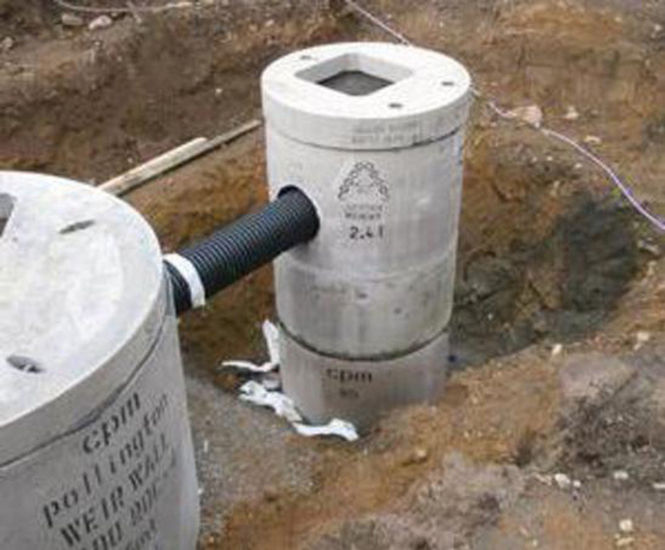
By working with Hydro International’s stormwater design team, BEAR Scotland specified a long term surface water drainage solution which delivered control of surface water flows and minimised any potential pollution from hydrocarbons into the watercourses below. The solution incorporated three Hydro-Brake® Flow Controls within pre-cast concrete weir wall chambers and a Downstream Defender® hydrodynamic vortex separator.
“Because of the gradients, surface area and other site characteristics, the volume calculations were complex. Hydro was able to design a minimal maintenance SuDS solution providing the required levels of treatment and combining effective flow control with efficient removal of sediments and any hydrocarbon contaminants” explains Darren McLennan, Senior Engineer for BEAR.
The basis of the scheme, undertaken by contractor, the Coffey Group, was to excavate and deepen the existing ditches. They were lined with heavy duty polyethylene to prevent seepage into the road structure then filled with carefully graded filter drain aggregate. A series of check dams limits flow through the new channels before discharging into a new pipeline constructed under the road.
Water flow in the pipeline is controlled by a series of three Hydro-Brake®Flow Control devices, located at 300 metre intervals in weir wall concrete chambers under the road. The controlled discharge of the Hydro-Brake® units also enables the pipeline to be used as a temporary storage chamber to help mitigate storm events.
The last of the three Hydro-Brake® units is located at the downslope end of the pipeline, in front of the Hydro Downstream Defender®. This device ensures high sediment retention even during storm events, with no re-entrainment, while controlling floatables and providing hydrocarbon separation. The Downstream Defender® discharges over a reinforced rip rap face set into the embankment to control erosion, and then to the river.
Outcome
“The result is an elegant solution which meets both the environmental concerns and the serious structural problem.” states Darren. “As the purity of water in the catchment is very important, and the safety of the infrastructure is greatly improved, we have achieved a good result.”