Padel is booming across the UK, with hundreds of new courts opening and many more in planning. But alongside this rapid growth comes a familiar challenge: noise complaints from nearby residents. Reports across the country have even described the sound of padel play as “gunshot like”, contributing to planning objections from Bath, Winchester, Weybridge and other communities.
Studies and acoustic assessments confirm that padel generates louder, sharper peak impact sounds than tennis, due to solid rackets, frequent ball on glass rebounds, and enclosed court structures.
Acoustic barriers are emerging as one of the most effective and aesthetically suitable options for reducing noise from padel facilities.
Noise created by padel courts
Research identifies several distinct noise sources:
1. Ball impacts on the glass back walls
These create the sharp “crack” sound often cited by residents.
2. Ball impacts on wire mesh fencing
These strikes create metallic, high frequency noise that travels efficiently over distance.
3. Racket strikes
The solid padel bat generates a louder, sharper hit than a strung tennis racquet.
4. Vocal noise
Padel is social, competitive, and played in doubles, leading to more vocalisation than tennis.
5. Continuous gameplay
Longer rallies mean more frequent impacts, raising both average and peak noise levels.
With these combined factors, residential disturbance has become a genuine planning issue across the UK.
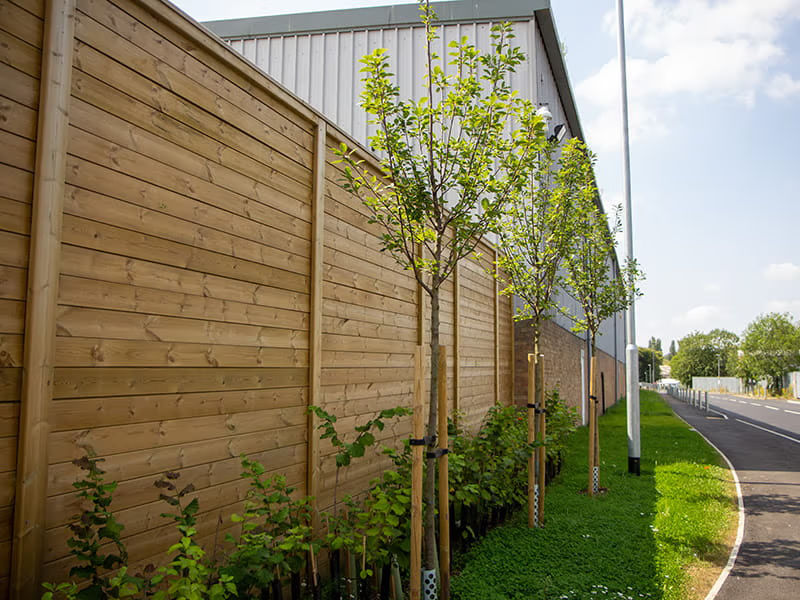
Padel court acoustic barriers
Why timber acoustic barriers are a strong fit for padel courts
Timber acoustic barriers are increasingly chosen for sports facility noise control. They offer several advantages, supported by industry guidance:
Natural appearance suitable for sports clubs and community settings
Timber blends seamlessly with surroundings and avoids the industrial look of concrete or metal barriers.High acoustic performance
Premium timber acoustic systems can achieve up to 28dB noise reduction for reflective designs and up to 32dB for absorptive designs.Long lifespan and reliability
Well engineered timber barriers, such as Jakoustic®, come with a 25 year guarantee against rot and insect attack. This ensures long term performance even in exposed outdoor sports environments.Reflective acoustic barriers bounce noise away from sensitive receptors.
Absorptive acoustic barriers reduce reverberation and prevent noise reflecting back into nearby areas.
UKCA marked systems for courts near roads
If a padel court is situated beside a road, any acoustic barrier must meet BS EN 14388:2005 and be UKCA marked as a certified noise reducing device. Timber systems such as Jakoustic® Commercial & Highway meet this requirement.
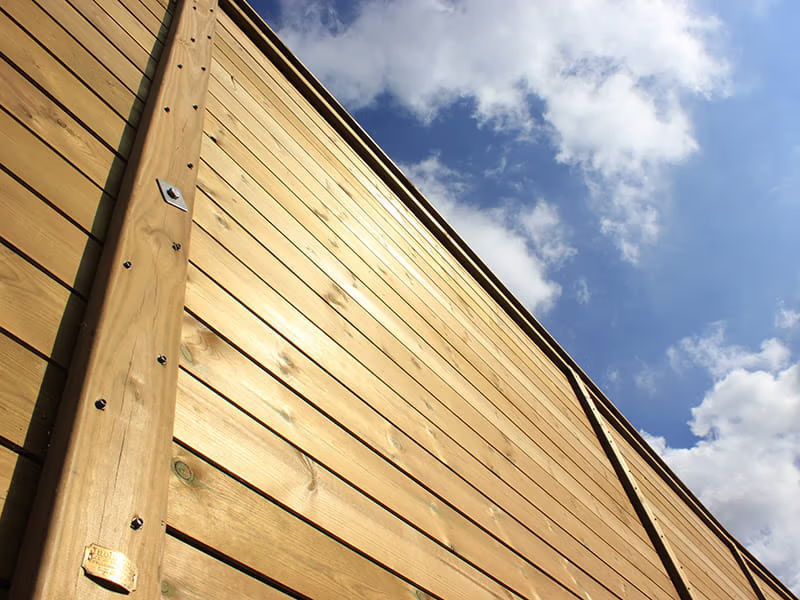
Timber acoustic barriers
What makes an acoustic barrier effective for padel noise?
To reduce padel court noise, barriers must be designed and installed to robust acoustic principles:
1. Sufficient surface mass and ‘airtight’ construction
Effective acoustic barriers must have:
Minimum mass density of 10 kg/m² (premium systems exceed 25–28 kg/m²).
No gaps or openings where sound can leak through.
High performance systems use 34mm thick interlocking boards to eliminate air pathways.
2. Appropriate height and length
Barriers must interrupt the line of sight between the court and the receiver.
Heights of 3m and above are commonly used in padel court assessments.
For example, a 3m high acoustic screen was recommended as effective in a 2025 noise assessment for courts at Cinderford RFC.
3. Correct distance from the noise source
Noise barriers work best when they are positioned as close as possible to the court, while still allowing safe circulation and emergency access.
Padel guidance notes emphasise that barriers must be close to the source to minimise diffraction (sound bending over the top).
4. Consideration of site layout and sensitive receptors
Positioning relative to homes, terraces, club buildings, and natural land contours all influence the acoustic modelling recommended by consultants.
5. Choosing absorptive vs reflective design
Use reflective barriers where noise can be deflected harmlessly into open areas.
Use absorptive barriers in enclosed or courtyard-like settings, where reflected noise would otherwise build up.
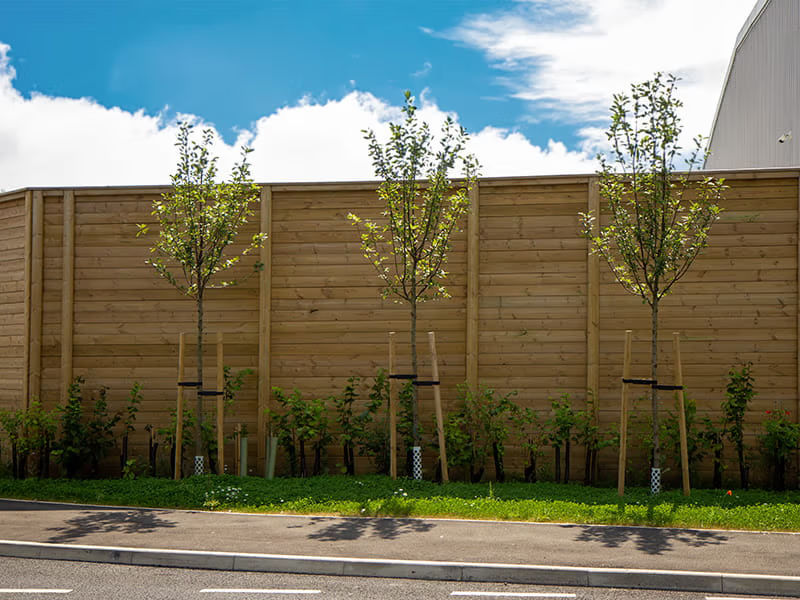
Timber fences create a reflective barrier for padel courts
Additional noise reduction strategies
Respect minimum distances from homes (often 100m or more where possible).
Orient courts so glass backs face away from homes.
Consider partial or full acoustic canopies for highly sensitive sites.
Indoor or semi covered courts significantly reduce external noise.
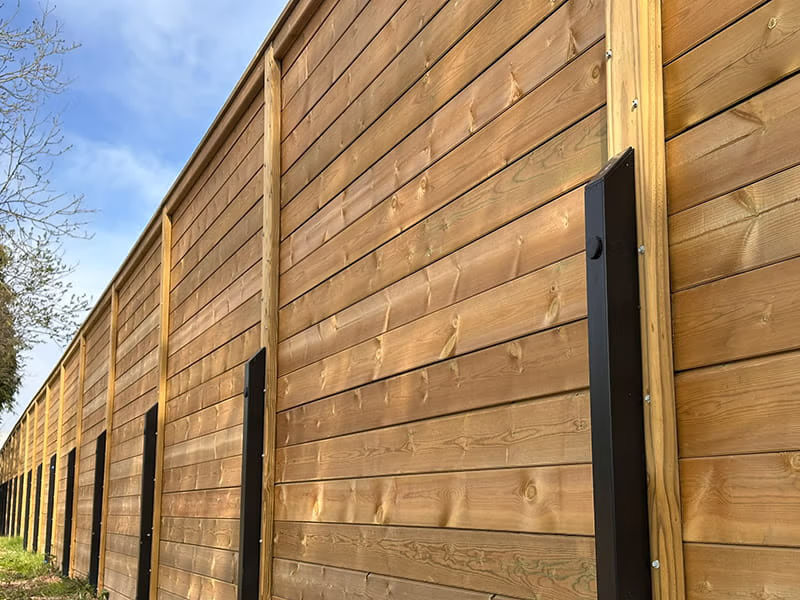
Padel court noise reduction barriers
Timber acoustic barriers offer a balanced, high performing solution
As padel continues its rapid expansion across the UK, noise management is becoming essential, not only for planning approval, but for good neighbourly relations.
Jacksons Fencing timber acoustic barriers provide:
Proven noise reduction capability (up to 32dB)
A natural appearance suitable for clubs and communities
Reflective and absorptive options
Long term durability with a 25 year guarantee
UKCA marked systems for installations near roads
Compatibility with acoustic consultant modelling and planning requirements
With proper design, positioning, and installation, acoustic barriers can transform padel courts from noise concerns into welcomed community assets allowing the sport to grow while protecting local residents’ quality of life.
Contact Jacksons Fencing for any project or padel court requiring a noise reduction solution.