

- Sector
- Transport infrastructure
- Project type
- Refurbishment
- Year completed
- 2022
- Project location
- South East England
- Client
- Costain CH2M / East Sussex Highways
- Consultant
- Gravitas International
- Products used
- Flex MSE® vegetated wall system
Context
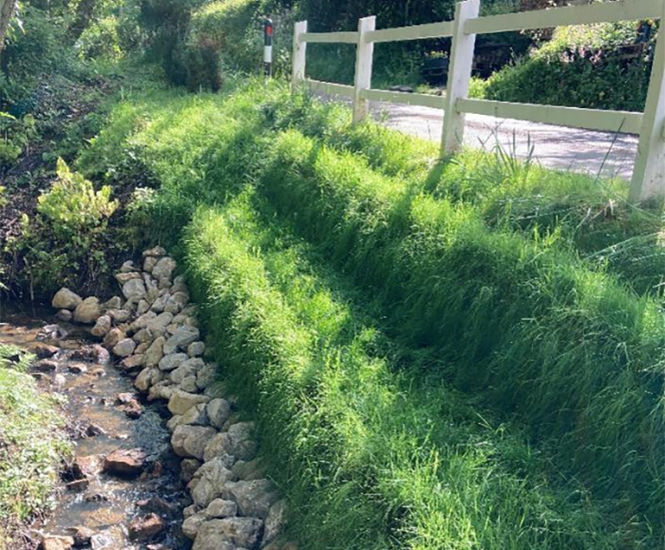
Gravitas International's Flex MSE® vegetated wall system was chosen by Costain CH2M for repair works to an area of carriageway embankment erosion, along a rural road at Motts Mill in Groombridge, East Sussex.
The site featured several construction constraints including narrow geometry, a fragile cast iron water main under the road, and overhead cabling in close proximity to the work area, to name a few. With these parameters restricting the use of lifting equipment and heavy machinery East Sussex Highways’ in-house Design and Build Team chose to explore an innovative new solution for the project with improved buildability compared to standard solutions, as well as being quality-assured and cost-effective to satisfy the project’s client. The Flex MSE® technical support was provided by Gravitas International.
Project achievements
The Flex MSE system design eliminates the use of hard-engineering materials in order to promote sustainable development and biodiversity within the local area. The success of the project has led to Flex MSE becoming the standard solution to embankment erosion, retaining walls and headwall repair projects for East Sussex Highways. Once vegetated, the patented Flex MSE (Mechanically Stabilised Earth) system will blend seamlessly into its natural surroundings, keeping this project in line with Costain’s Climate Change Action Plan to lead UK infrastructure into a zero-carbon future by 2035, supporting the Government in meeting its 2050 target.
Design overview
In normal conditions, the watercourse is a picturesque meandering stream, enjoyed by the locals. Four retaining wall solutions were considered for the project, each assessed in terms of constructability, long-term maintenance requirements, environmental impact, and cost. Of the four options, three were traditional, hard-engineered solutions, namely: sheet piling, gabion baskets, and a proprietary precast concrete segmental block system. The fourth option was a vegetated bag-work wall solution named Flex MSE. This was the solution recommended to the client by the East Sussex Highways’ Design and Build team and was ultimately accepted for construction.
The system consists of interlocking plate and bag components which are laid in a brick-bond formation. All materials used are inert and therefore will not result in any pollution to nearby land or watercourses. Flex MSE promotes biodiversity within the local area, as it accepts almost all types of vegetation, so it is not limited to specific environments. The environmental team at East Sussex Highways chose a mix of creeping red fescue and rough meadow grass for the Motts Mill project, as it would adapt well to the damp and shady environment.
Flex MSE bags allow for root penetration, unlike conventional materials such as concrete, so they encourage vegetation growth, and the wall becomes stronger with time as the roots act as tensile reinforcement. Furthermore, the units are incredibly flexible meaning they can be installed around any mature trees or awkwardly-shaped bedrock, causing far less damage during construction. This extends to structures that are already present, such as culverts or bridge abutments. Using the Flex MSE design also minimises the hydrostatic pressures behind the wall as the system is free-draining, and able to withstand unlimited differential settlement.
The units are faster and safer to install than other conventional solutions as they require a limited foundation and can be placed by hand, eliminating the need for large, fuel-guzzling site machinery. As many of the East Sussex erosion sites are on narrow, rural roads, this is a huge benefit in terms of ease of access and noise disturbance to local residents.
The retaining wall at Motts Mill has a wall face area of approximately 30m2 with 575 Flex MSE units installed on this installation, It is therefore estimated that it would take 2 acres of mature forest, or 54 tree seedlings 10 years to capture the same amount of CO as the new Flex MSE wall will. It will also require approximately 2000kg less greenhouse gas to construct compared to if a segmental concrete wall had been built. This figure is equivalent to nearly half of a passenger vehicle’s annual emissions or a third of a household’s annual emissions from electricity usage.
Using a conventional system such as gabion baskets would have incurred larger construction costs due to the hire of large plant and the excavation of a substantial foundation, as well as increased maintenance costs due to likely repairs to the steel cages which degrade over time in an area prone to watercourse erosion.
The bags have been used on 5 different projects at East Sussex Highways since their debut at Motts Mill in October 2021, all of which have now blended beautifully into their natural environment.