

- Services provided
- Installation
- Year completed
- 2022
- Project location
- Scotland
- Client
- Lagan Aviation & Infrastructure / Defence Infrastructure Organisation (DIO)
- Products used
- SDS Weholite wastewater storage tanks, manholes and conveyance piping
Overview
SDS Weholite wastewater storage tanks, manholes and conveyance piping have been installed at RAF Lossiemouth, to prepare and future-proof the base for the introduction of Boeing P-8A Poseidon Maritime Patrol Aircraft.
Located in Moray, north-east Scotland, this is one of two RAF Quick Reaction Alert (QRA) stations, whose aircraft and crews are on continual high alert in order to scramble and intercept unidentified aircraft approaching UK airspace.
The MOD has committed to a £3bn investment for the transformation of the base, which is staffed by more than 3,000 military and civilian personnel.
Brief
The brief was to ensure the full operational capabilities of the air base are not compromised by flooding from heavy rainfall.
The aim was to disperse surface water quickly and efficiently from the air-side paved surfaces of the base.
SDS was required to implement a drainage scheme that enables sustainability objectives to be met at every stage of the project.
Surface water system requirements
The system complies with the Water Environment (Controlled Activities) (Scotland) Regulations 2011 (CAR) which have made SuDS a requirement for all new developments constructed after April 2007.
Special attention has been paid to the potential flood risk due to the coastal location of the site in an area of Scotland which is known for its wet and harsh weather, particularly in Winter when snow melt can create significant volumes of standing water.
SDS product features
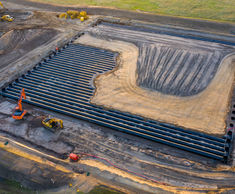
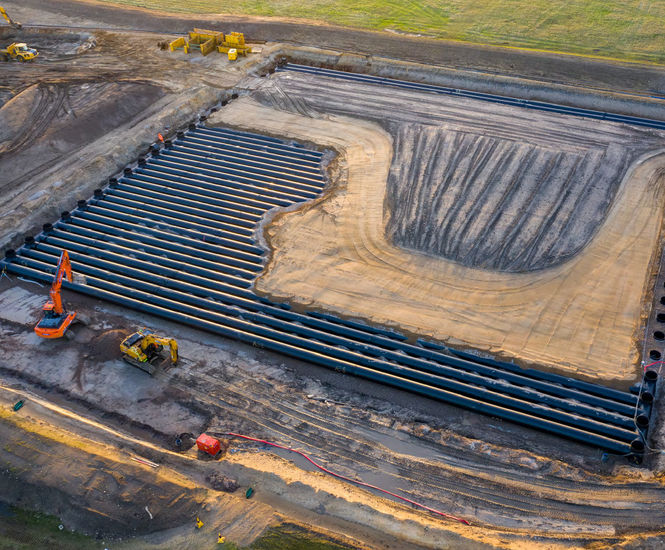
The 90x90m Weholite tank is constructed predominantly of 260 individual pipes of 14m in length, and 50 pipes of approx 7m in length, all with a 1.2m diameter.
In excess of 4.4km of 1200mm-dia 4K pipe, together with 10 manholes, have been manufactured and installed by SDS, with a combined bill of materials weight of over 300 tonnes.
Issues overcome
All stormwater attenuation is situated below ground due to the restriction of having open bodies of water in close proximity, which might attract unwanted birds to the airfield.
Due to site levels and the relatively high water table, soakaways were deemed unsuitable for stormwater discharge, therefore the flow rate is restricted to 5 litres per second per hectare of impermeable area before discharging into the drainage system.
Oil interceptors located between the drainage system and the neighbouring Covesea Burn help to prevent any contaminated run-off from the runway from entering the natural environment.
Testimonial
“Safe, tidy and impressive work rate by all within our Central and Eastern section at RAF Lossiemouth. Works have comprised a new wastewater treatment works, 90m x 90m oversized attenuation tank, roads, drainage and associated Infrastructure.”
– Malachey Doyle, Project Manager, Lagan Aviation & Infrastructure