
- Product name
- SDS Weholite Jointing Systems
- Suitability
- Foul water drainage
- Land drainage
- Surface water drainage
- Product accreditation
- WRc approved
The most efficient method of joining is selected for each specific application, in order to ensure that the pipeline remains watertight, durable and effective despite the potential for poor ground conditions where there is the risk of excessive movement.
Heat Extrusion Jointing
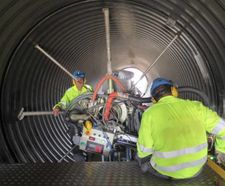
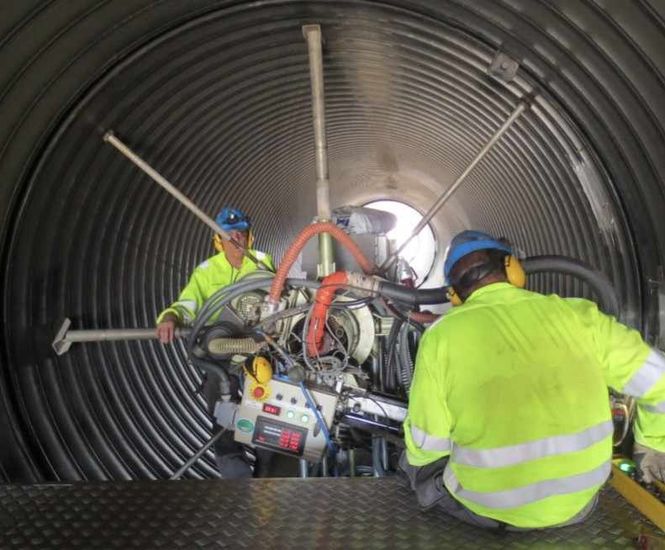
This process provides an economical and fast method of delivering a continuous long length of pipeline, test-proven to be the industry's strongest and most reliable method of joining structured wall pipes of diameters up to 3.5 metres.
The welding conforms to DIN DVS 2207 "Welding Thermoplastics - Extrusion Welding of Pipes, Piping Parts and Panels."
Pipe sections are welded together using a substantial amount of Weholite material; the tensile strength of the weld is even stronger than the yield stress of the profile, ensuring that any two sections of pipe behave as one homogeneous pipeline.
Lateral Connections
The WRc-approved, Universal Adaptor (UA) Saddle, manufactured by Flexseal, can be used with Weholite. When used in conjunction with a Flexseal coupling it is an easy-to-fit product for connecting 160mm laterals into Weholite post-installation.
Mechanical Couplings
Mechanical Couplings are popular with Water Companies, civil engineers and building contractors as it allows generous pipe angulation, expansion and contraction. It has been used on Weholite in sizes up to 3.3 metres in external diameter.
Weholite Flat Bands
Manufactured from HDPE and with a design life as long as Weholite, these flexible bands are used for
sand tight joints or for location purposes.
Others
We are able to manufacture and supply PN, bespoke and puddle flanges by design, and to produce
HDPE Wall Couplers for casting into concrete structures.
Weholite products often exceed the applicable
standards required by industry.
European Standard BS EN 13476
The standard has been specifically written for structured wall pipe systems made only from one of three materials: HDPE, PP or PVC. As stated by the CEN committee (the European Committee for Standardisation), it is not applicable to, and therefore cannot be used as, a standard for pipes made from other materials, combinations of materials (composite pipes) or pipe systems that do not belong to the clearly defined structured wall family.
BS EN 13476 covers all aspects of the system for foul and surface water sewers, including factors such as raw materials, wall thicknesses, impact resistance, ring flexibility and structural design requirements.
WRc
Weholite systems, including any welded joints, are certified by WRc. The product meets the requirements set out in WRc Assessment Schedule PT/412/1117-AS – for Weholite Pipe Systems with welded joints in diameter from 900mm to 3500mm (current licence valid until 1/11/2022).
Kitemark
Weholite systems, including any welded joints, are certified by Kitemark. Licence no. KM 560128 covers the manufacture of Weholite pipes, fittings and joints from DN400 to DN3000 diameter.
BBA HAPAS
Weholite pipe systems from 450mm to 3500mm internal diameter are approved for use by Highways Authorities in England, Wales, Scotland and Northern Ireland as drainage structures.
Approved for use in public water supplies
Weholite is “Approved for use in public water supplies” DWI Regulation 31 Reference number DWI: DWI 56.4.513a – Weholite Tanks (Pipes and Panels) which is in section B1.1 Polyethylene (PE) Pipes; DWI 56.4.513b – Weholite Tanks (Pipes and Panels) which is in section E.1. Tanks.